
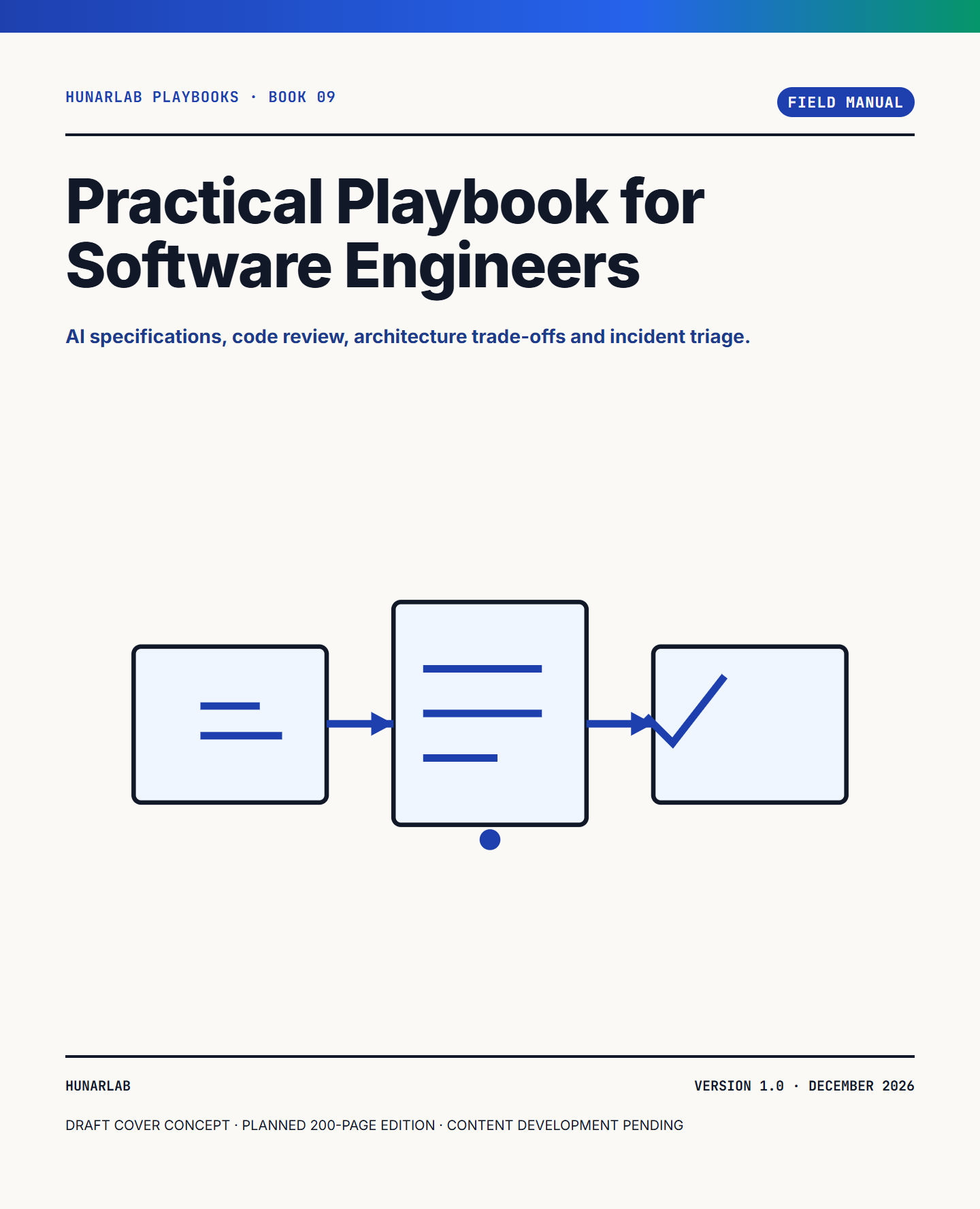
Practical Playbook
for Software Engineers
AI specifications, code review, architecture trade-offs and incident triage.
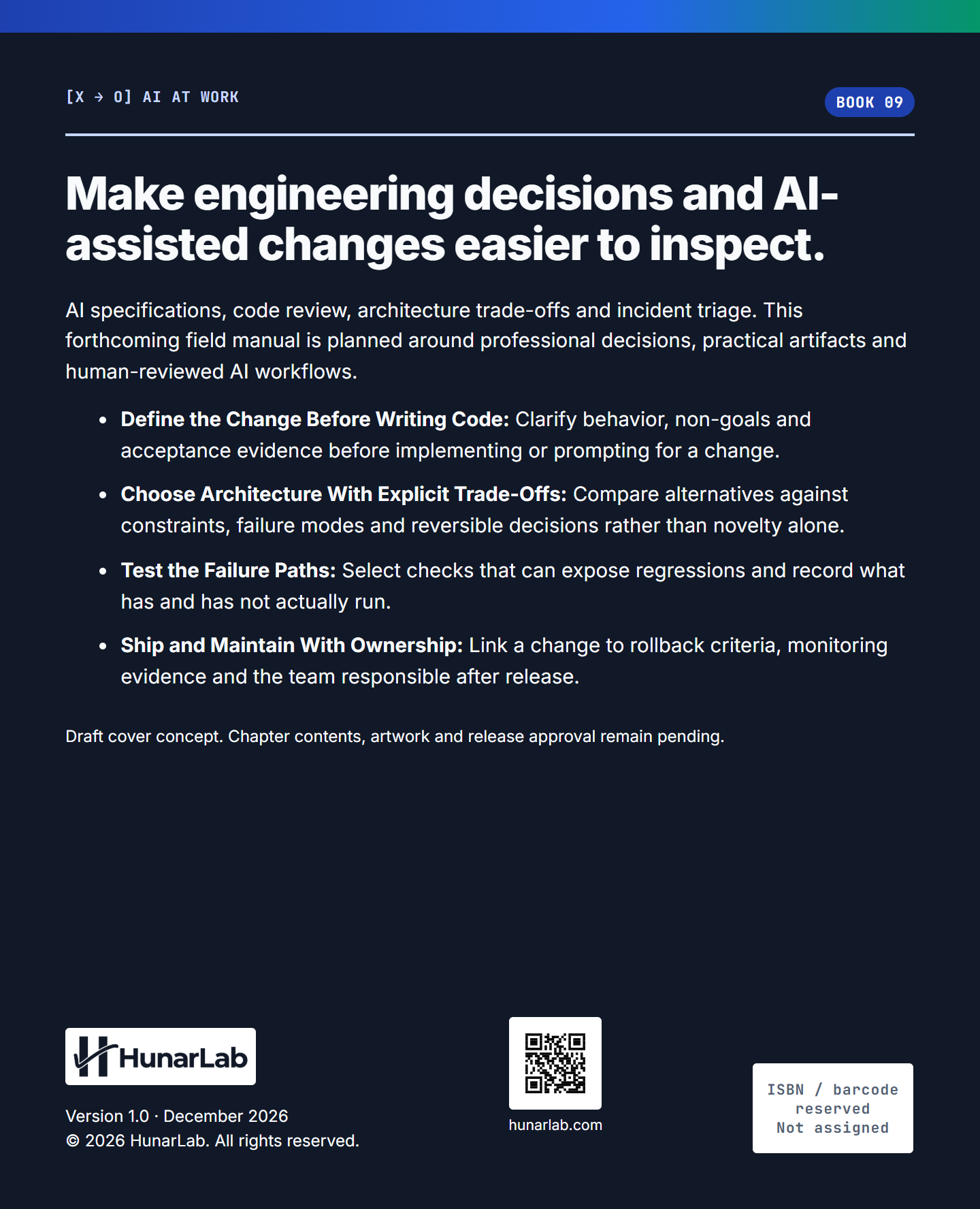
Make engineering decisions and AI-assisted changes easier to inspect.
Forthcoming · Target Release: December 2026
This title is part of the planned 12-book flagship series. Version 1.0 · December 2026 is the release target. Purchases and downloads are not available yet.
Chapter lineups and cover concepts are proposals. Research, manuscript production, tool checks, independent review and release approval remain pending.
LOOK INSIDE
Preview the Book
Two draft cover concepts exported from the 7.5 × 9.25 master. These are proposed covers, not samples from a completed manuscript. Interior preview pages will be added after drafting and review.
THE PLANNED RELEASE
What You Get When It Is Released
- A Planned 200-Page Illustrated Book
Nine proposed chapters, each using the series’ 10-spread structure for frameworks, practical plays, examples, scripts and reflection.
- Nine Planned Field Toolkits
One fill-in working artifact per chapter. Final printable and editable formats, access details and compatibility will be confirmed before release.
- AI Workflows With Human Checks
Planned task-focused workflows with source checks and human ownership. Tool selection and hands-on testing have not been completed for this title.
INSIDE BOOK 09
The Nine Plays
Proposed chapter and toolkit plan. This is a development outline, not a claim of completed or validated manuscript content.
- Chapter 01
Define the Change Before Writing Code
Planned Field ToolkitChange Intent & Acceptance Brief
Clarify behavior, non-goals and acceptance evidence before implementing or prompting for a change.
- Chapter 02
Map the Codebase and Its Boundaries
Planned Field ToolkitCodebase Context & Dependency Map
Find the relevant owners, interfaces and dependencies before relying on an AI explanation of unfamiliar code.
- Chapter 03
Choose Architecture With Explicit Trade-Offs
Planned Field ToolkitArchitecture Decision Record
Compare alternatives against constraints, failure modes and reversible decisions rather than novelty alone.
- Chapter 04
Write AI-Assisted Specs That Can Be Tested
Planned Field ToolkitSpec & Evaluation Checklist
Translate a request into testable behavior, edge cases and review criteria with a human decision owner.
- Chapter 05
Review the Diff, Not the Explanation
Planned Field ToolkitCode Review & Risk Sheet
Inspect behavior, tests, dependencies and security-sensitive changes instead of trusting a fluent generated rationale.
- Chapter 06
Test the Failure Paths
Planned Field ToolkitFailure-Mode Test Matrix
Select checks that can expose regressions and record what has and has not actually run.
- Chapter 07
Debug With Evidence
Planned Field ToolkitDebugging Hypothesis Log
Use observations, controlled changes and reproducible checks to narrow a fault before accepting an explanation.
- Chapter 08
Triage Incidents Without Guessing
Planned Field ToolkitIncident Timeline & Decision Log
Separate observations, hypotheses and authorized mitigation while preserving the incident record.
- Chapter 09
Ship and Maintain With Ownership
Planned Field ToolkitRelease & Maintenance Handoff
Link a change to rollback criteria, monitoring evidence and the team responsible after release.
WHO IT IS FOR
Software Engineers.
For practicing software engineers who already work with a codebase. This is a planned workflow manual, not a beginner language course, a secure-coding certification or authorization to change production systems.
Testing Status & Honest Limits
Planned testing
Each chapter’s examples, scripts, worksheets and AI checks must be developed, reviewed and tested before release. No completed test or buyer-validation result is claimed for this title.
Scope and privacy
For practicing software engineers who already work with a codebase. This is a planned workflow manual, not a beginner language course, a secure-coding certification or authorization to change production systems.
Do not paste secrets, credentials, private customer records or proprietary source into unapproved AI tools.
SERIES ROADMAP
Explore the Series
Wave 1 · Books 01–12 · Target December 2026. All titles remain forthcoming.
Product & Design
AI & Analytics
Delivery & Leadership
Digital Business
Frequently Asked Questions
Is this a coding tutorial for beginners or a production-workflow playbook?
The proposed book focuses on professional engineering workflows around existing codebases, including specifications, review, architecture trade-offs, and incidents. It is not intended to replace language fundamentals or a team’s engineering standards.
How should engineers review an AI-generated pull request?
Inspect the behavior change, test evidence, dependencies, and security-sensitive paths before accepting it. The proposed Code Review & Risk Sheet supports that review; generated code still needs the same accountable engineering checks as other code.
Does following the playbook guarantee secure or correct code?
No. The planned workflows help make assumptions and review checks explicit, but they cannot guarantee correctness, security, or incident prevention. Use your team’s tests, review process, and appropriate specialist checks.
Requirements & Compatibility
Final delivery formats, required apps, supported versions, accessibility details and any AI-tool requirements will be confirmed before release. Companion access instructions and any account or purchase-verification requirements will be stated with the released files.
Price, license, refund terms and support arrangements will be published before checkout is enabled. Purchases and downloads are not available yet.
HunarLab · Page content reviewed